Colin Cantwell's Original Five
The five concept models that launched a visual revolution
Before there were filming miniatures, before there was Industrial Light & Magic, there was Colin Cantwell working alone in his apartment with foam, plastic, and George Lucas’s rough sketches.
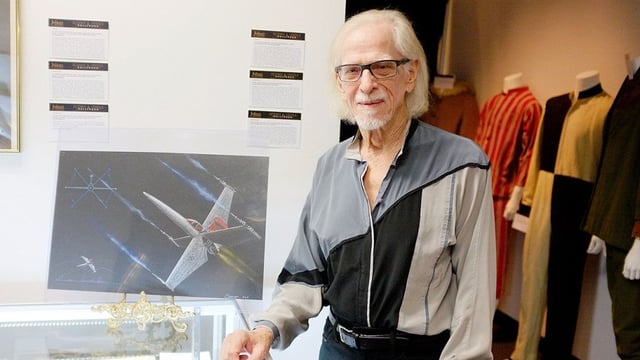
In 1975, Lucas hired Cantwell — a NASA illustrator and technical advisor on 2001: A Space Odyssey — to build the first three-dimensional concept models for his space opera. The result was a set of designs so powerful that they not only convinced a skeptical studio to fund the film, but established a visual language that has endured for half a century.
Cantwell’s approach was revolutionary in its simplicity. Rather than starting with detailed blueprints, he worked intuitively, letting the materials guide the form. The X-Wing’s split wings were a practical solution to a photography problem. The Death Star’s concave dish was a molding accident. The Star Destroyer’s dagger shape emerged from a single bold geometric choice.
These “happy accidents” became the foundation of the Star Wars aesthetic: functional, asymmetric, and somehow both futuristic and ancient. Every Star Wars ship designed since — from Doug Chiang’s Naboo fighters to Ryan Church’s Razor Crest — exists in dialogue with Cantwell’s original five models.
Works in This Collection
X-Wing Fighter — Concept Model
Colin Cantwell
Imperial Star Destroyer — Concept Model
Colin Cantwell
TIE Fighter — Concept Model
Colin Cantwell
Death Star — Concept Model
Colin Cantwell
Death Star — The Original Flaw
Colin Cantwell