Terryl Whitlatch and the Biology of Star Wars
Artist: Terryl Whitlatch · 1996
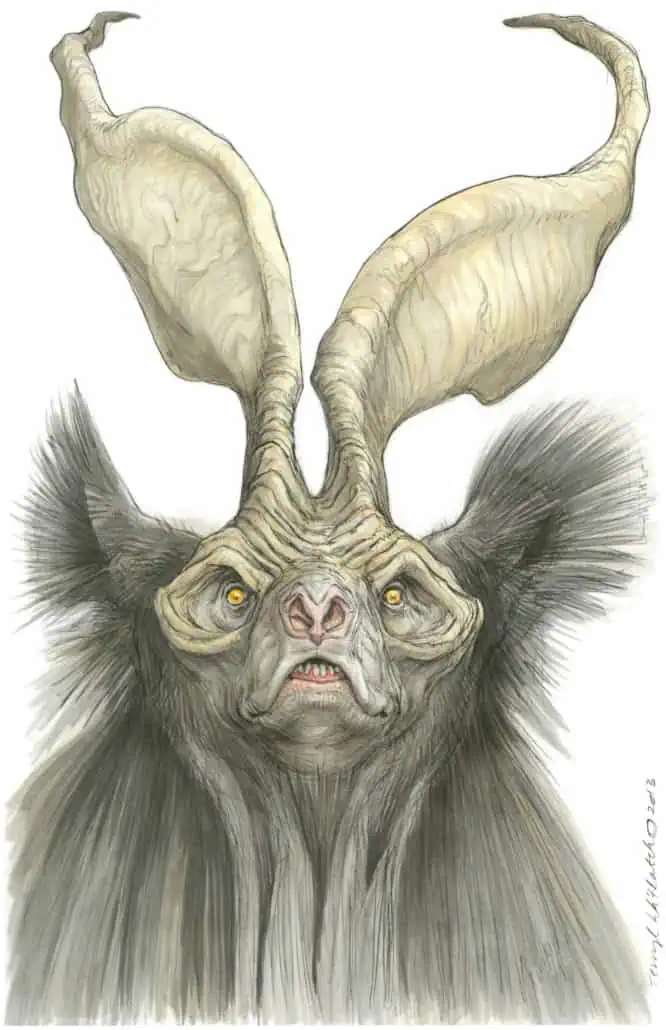
Terryl Whitlatch didn't just draw aliens — she dissected them. Her creature designs for The Phantom Menace came with full skeletal structures, muscle maps, and evolutionary histories.
Most concept artists design creatures from the outside in — starting with a cool silhouette and working backward. Terryl Whitlatch designed from the inside out. Her background in paleontological reconstruction and veterinary anatomy meant that every creature she created for The Phantom Menace had a skeleton before it had skin.
Whitlatch's design documents for the film read less like Hollywood production art and more like xenobiological field studies. Her sketches of the Opee Sea Killer include cross-sections showing swim bladder placement, jaw musculature diagrams, and notes on feeding behavior. The Kaadu — the duck-billed mounts ridden by the Gungans — have full skeletal overlays showing how their leg joints would actually support a rider's weight.
'If the biology doesn't work, the audience feels it even if they can't articulate why,' Whitlatch has explained. 'A creature that couldn't actually walk or breathe or eat registers as wrong on a subconscious level. My job is to make the impossible feel inevitable.'
Her most extensive work was on the Eopie — the long-snouted pack animals seen in the Tatooine scenes. Whitlatch produced a complete evolutionary lineage, showing how the Eopie descended from smaller, faster desert predators that gradually adapted to a herbivorous, domesticated role over thousands of generations. She even designed the internal nasal cooling system that would allow a large mammal-analog to survive in a desert environment.
The Whitlatch approach has influenced creature design across the industry. Her published sketchbooks have become essential reference for concept artists, and her insistence that fantasy biology must be grounded in real biology is now a standard philosophy at ILM and Lucasfilm's art departments.