Pat Presley and the Sacred Architecture of Jedha
Artist: Pat Presley · 2015
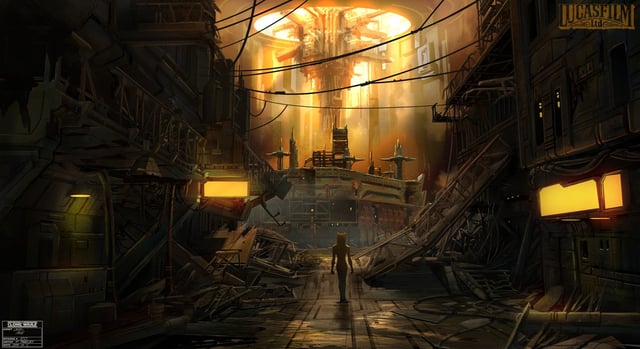
For Rogue One, concept artist Pat Presley drew on centuries of real-world religious architecture to build a holy city that felt ancient, contested, and alive.
When Gareth Edwards began assembling the visual language of Rogue One, one of the most ambitious design challenges was Jedha — a desert moon that had to feel like the spiritual heart of the galaxy. Concept artist Pat Presley was tasked with building a city that communicated millennia of pilgrimage, conflict, and devotion through architecture alone. His early paintings borrow freely from Petra, Varanasi, and the rock-hewn churches of Lalibela, layering these influences into something unmistakably Star Wars.
Presley produced over sixty paintings of Jedha across a nine-month period, each one refining the relationship between the ancient Jedi temple at the city's core and the Imperial occupation scarring its streets. His technique — large gestural brushwork in Photoshop with photographic texture overlays — gave the paintings a cinematic immediacy that Edwards responded to immediately. "Pat's paintings felt like stills from a movie that already existed," Edwards later recalled.
One of the most striking aspects of Presley's Jedha work is his treatment of scale. The temple structures dwarf everything around them, their facades carved with symbols that predate the Republic. Stormtroopers patrol streets that were old before the Empire was born. This tension between ancient sanctity and modern militarism became the visual thesis of the entire Jedha sequence.
Several of Presley's unused concepts showed the temple interior in greater detail — vast chambers with kyber crystal formations growing through the floor like geological cathedrals. Though these interiors were simplified for production, the paintings reveal a world far more elaborate than what reached the screen, suggesting Jedha's spiritual significance ran deeper than the film had time to explore.