Erik Tiemens and the Volcanic Poetry of Mustafar
Artist: Erik Tiemens · 2003
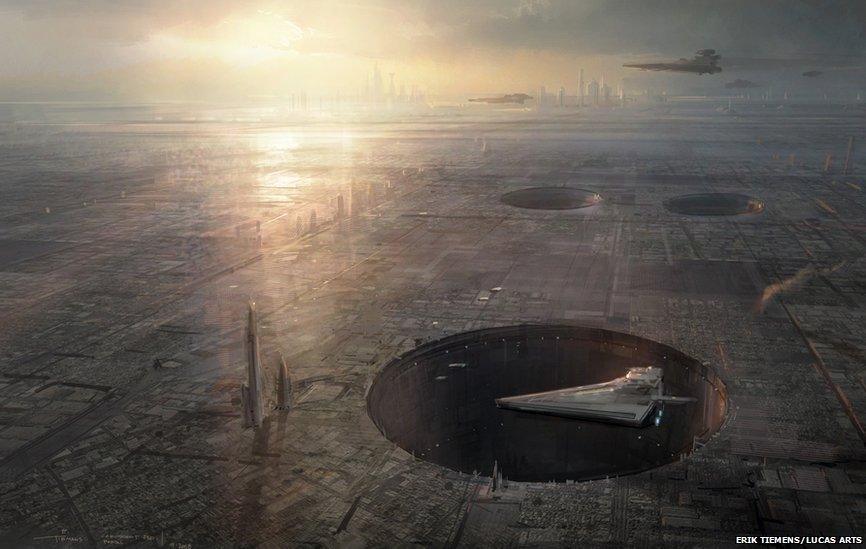
Tiemens painted Mustafar not as a hellscape but as a tragic landscape — a world of terrible beauty where fire and ruin create their own kind of grandeur.
Erik Tiemens had already established himself as one of Lucasfilm's premier digital matte painters through his work on Attack of the Clones when he was assigned the defining environment of Revenge of the Sith: Mustafar. George Lucas's direction was characteristically cinematic — "I want the audience to feel the heat" — and Tiemens responded with a body of work that ranks among the most visually ambitious environment art in blockbuster history.
Tiemens approached Mustafar not as a generic lava planet but as a study in Romantic-era landscape painting filtered through science fiction. His reference folder contained Turner's seascapes, Frederic Church's volcanic paintings, and NASA imagery of Io's sulfur plains. The synthesis is visible in every painting: lava flows that behave like Turner's waves, volcanic plumes that catch light like Church's tropical sunsets, mineral formations that echo Io's alien geology.
The production required over forty distinct matte paintings for the Mustafar sequence, and Tiemens personally executed twenty-three of them. Each one had to maintain visual consistency while supporting wildly different emotional beats — from the eerie calm of Anakin's arrival to the apocalyptic fury of the duel's climax. Tiemens solved this by establishing a color script that shifted the palette from deep crimsons and blacks to increasingly saturated oranges and whites as the sequence progressed, mirroring Anakin's descent.
Perhaps the most remarkable paintings are the ones that never made it to screen — a series of "aftermath" views showing Mustafar's landscape in the wake of the duel. These quieter compositions show cooling lava forming new stone, suggesting that even in destruction, the planet continues its geological cycle. Tiemens described them as "the planet breathing after the fight." Lucas loved them but felt they undercut the emotional devastation of the scene.
What endures in Tiemens's Mustafar work is the insistence that even a hellscape can be painted with reverence. The lava is destructive but luminous. The formations are alien but compositionally grounded. It is landscape art in the fullest tradition — nature as emotional mirror — translated into the vocabulary of a galaxy far, far away.